When I'm teaching a beginner class, someone always raises their hand with the same question: "Which market should I actually start in?" And honestly, it's the right question. Because the market you choose determines everything — your schedule, your capital requirements, your psychology, how you trade, and ultimately whether you stick with it or burn out.
Here's the thing though: there is no single "best" market. There's the best market for you, your lifestyle, your capital, and your temperament. And the beautiful part? You don't have to choose just one forever. The most successful traders I know move between all three — forex for consistent income, futures for focused leverage, and crypto for volatility opportunity. But we start somewhere. So let's break down what you're actually getting into with each one.
Forex vs Stocks vs Crypto: Which Market Should You Start With?
I teach forex, futures, and crypto because I trade all three and our community members do the same. And I've noticed something: the decision often isn't about which market is "best" — it's about which one fits your actual life right now.
Forex is where most of our women start, and I'll tell you why. It's 24/5, which means there's no alarm clock required. You can trade at 5 AM before your kids wake up, during lunch breaks, after work, late at night. That flexibility alone is massive for women juggling jobs and families. The capital requirements are also much lower — you can start with as little as $100 to $500, and you can properly risk 1-2% of a small account without blowing it up in three trades.
Crypto is what we dive into in our weekly broadcasts with Corinne, and it's completely different. Bitcoin and the altcoin market move 24/7 — they don't care what time zone you're in or whether it's a holiday. That volatility can be thrilling if you have strong psychology and decent capital. But crypto will test you emotionally. You'll see 10% moves in hours. You'll watch your account swing $5,000 in a day. If that doesn't sound like a feature to you, it's a bug.
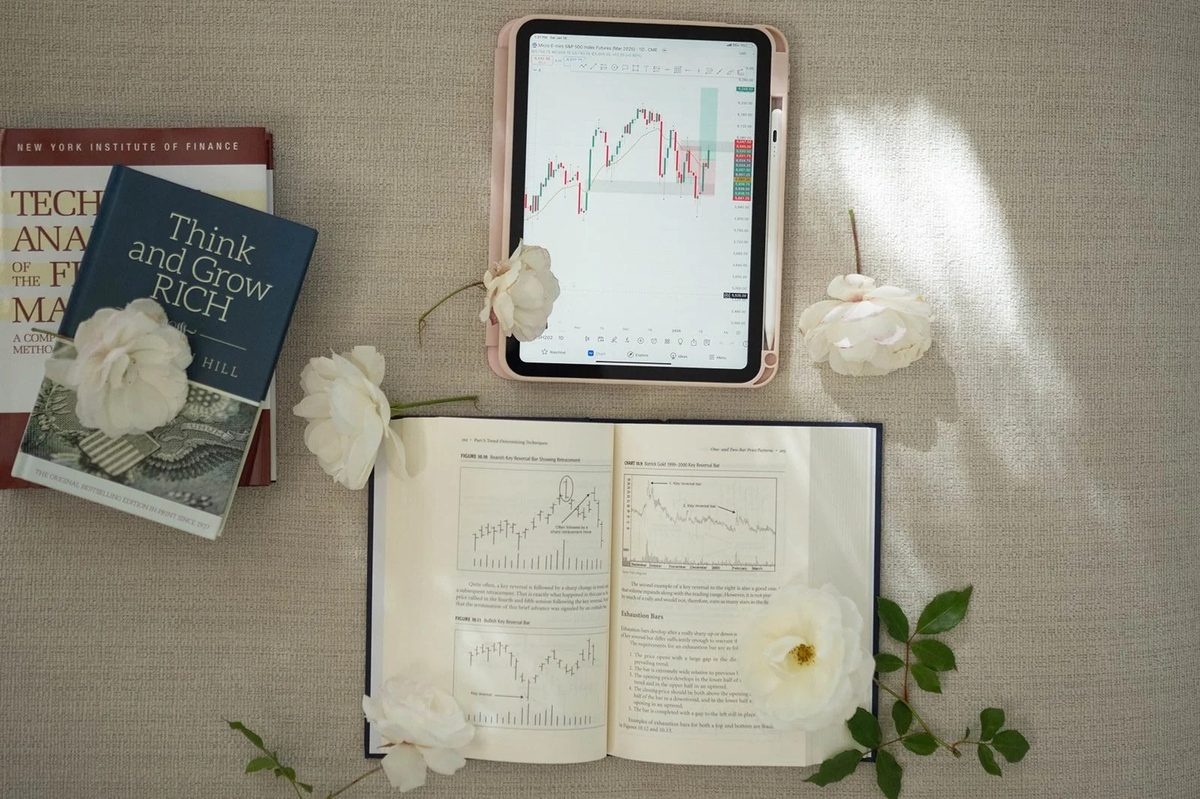
Futures is what I personally trade the most now, and honestly, it sits between the two. You get leverage like forex, volatility like crypto, but with structured market hours. When I announced futures trading on Skool a few weeks back, the response was overwhelming — 280 likes on the post about futures, 280 on the one about understanding forex versus futures. That tells me people are really hungry to understand this market, but they're also uncertain about it.
"The women who work with us actually trade in these markets using the same systems we teach you. Forex, futures, crypto — the core is the same. Risk management. Discipline. Patience. The market just changes, but your mindset doesn't."
Why Most Women Start with Forex
Let me be direct: forex is the entry point for a reason. Not because it's the easiest to profit from — it's not. But because it fits life. You can open a forex account with $100-$500. You can trade during the Asia session at 6 AM, the London session at 8 AM, or the New York session in the afternoon. There's no pattern day trading rule saying you need $25,000 just to be allowed to trade. Your broker won't lock you out of the market because you're new.
Here's what a realistic forex day looks like for most of our members: 30 to 60 minutes. You scan your pairs — the ones you've decided to focus on based on the system we teach — you wait for your setups, you place your trades, and you're done. Not because you're lazy or trying to time the market perfectly, but because you've learned to trust your rules. We teach you to look for A+ entries. Not every candle. Not panic trades. A+ entries. That means most days you take zero trades. Some days you take one. Occasionally you take two. And you close your account and move on with your day.
The currency market is also driven by fundamentals that actually exist. Interest rates. Inflation data. Economic announcements. These are published on a schedule. You can learn them. You can track them. It's not purely emotional speculation like crypto can be.
"I passed FIVE combines across two firms in the last 24 hours. I stuck to my system. I stayed with the mindset. Slow is smooth. Smooth is fast."
How TFW Members Trade Across Multiple Markets
Once you understand the core — position sizing, risk-reward ratios, entry and exit rules, emotional discipline — the actual market becomes almost secondary. One of our members wrote that she's been with us for 15 months and passed her first funded account. The foundational knowledge transformed her completely. And here's what she didn't do: she didn't choose one market and ignore the rest. She learned forex, she studied the systems, she built consistency, and then she started exploring futures and crypto too.
This is the TFW approach that actually works. You don't wake up tomorrow and decide to trade all three markets at once. That's chaos. That's how you blow accounts. Instead, you do this:
Month 1-3: Learn forex. Trade one system on one pair. Build a foundation. Get comfortable with placing orders, managing a position, accepting losses, celebrating small wins. If you can't make consistent decisions on EUR/USD, crypto volatility is going to destroy you.
Month 3-6: Add a second timeframe or expand to two pairs if you're crushing it. This is when you start building consistency — which means you can handle bigger positions, which means you can actually see results that matter.
Month 6+: Now your brain is ready. You've done the psychology work. You understand risk management in your bones. You can add crypto during your off hours. You can paper trade futures. You're testing, not all-in betting.
The women who show up to our mindset calls, who journal their trades, who trade their plan instead of their emotions — those are the ones who graduate from one market to three. And when they do, they do it with systems that work, not hope.
"When we do the Crypto Weekly broadcast, we look at the big picture first. Bitcoin dominance. Overall market cycle. Then the opportunities. But here's the thing — trading crypto is an emotional game. Everybody wants to learn when Bitcoin is at all-time highs and they see excitement everywhere. Then we get boring times and everyone disappears. That's why you need the foundation first."
| Factor | Forex | Futures | Crypto |
|---|---|---|---|
| Trading Hours | 24/5 | US Market Hours + Overnight | 24/7 |
| Minimum Capital | $100-$500 | $1,000-$2,000 | $100-$500 |
| Leverage | Up to 1:500 | Up to 1:50 | Up to 1:125 |
| Volatility | Low-Medium | Medium-High | Very High |
| Learning Curve | Medium | Medium | Hard |
| Psychological Difficulty | Medium | Medium-High | Very High |
| Time Commitment | 30 mins - 1 hour/day | 1-3 hours/day | 15 mins - 8 hours/day |
What Each Market Actually Demands From You
Forex demands discipline more than anything else. It's slow enough that you have to wait for your setups. You'll have days where you scan for six hours and never enter a trade. That's the point. That's the profit. Accepting the days you don't trade is harder than people think.
Futures demands focus and capital. You're working with leverage on an asset that moves faster than forex pairs. A 3% move in NQ (the Nasdaq futures) will swing your account hard. But the moves are also clearer, the edges are sharper, and if you've mastered forex, you'll understand the mechanics immediately.
Crypto demands conviction and psychology. You will see your account down 40% in a week. You will watch Bitcoin hit all-time highs and then lose 20% overnight. Every beginner who joins crypto thinking "I'll just hold" learns this the hard way. Crypto isn't for the weak-minded. It's for people who have already proven they can execute a plan when the market is against them.
What we teach: One market. One system. One entry condition. Trade it until you could execute it in your sleep. Then and only then do you add another market. The traders who try to master three markets simultaneously are the ones who blow accounts trying to trade all three badly.
"I've been with Trading For Women for 15 months and I've passed my first funded account. The foundational knowledge and mindset work transformed me completely."
How to Choose Your Starting Market
You can't think your way into this decision. You have to feel your way into it. Here are the actual questions:
Question 1: How much time can you actually commit? If you have a job and you can only trade 30-60 minutes a day, forex is non-negotiable. You need that flexibility. Futures requires defined hours. Crypto you can check anytime, but if you're checking it every five minutes, you're trading emotionally, not systematically.
Question 2: How much can you afford to start? If you have $500, you're trading forex. If you have $2,000, you can do futures. Crypto works with any amount, but capital matters because 1% risk needs to be real enough to teach you discipline but small enough to survive your learning curve.
Question 3: What's your actual risk tolerance? Not what you think it is. How did you feel last time an investment moved down 10% in one week? If you panicked, crypto is a no for you right now. If you felt nothing, you might be under-leveraging. Forex and futures sit in the middle because they move slower but leverage harder.
Question 4: Why are you actually doing this? If it's to replace a job, you need consistent income, which says forex swing trading. If it's for excitement, you're going to chase crypto and blow your account. If it's for long-term wealth, honestly, stocks and index funds win. But if you're here, you're here for something else — autonomy, skill-building, a challenge. That's when these markets make sense.
The women who succeed don't pick a market and pray. They pick a market that fits their reality, they commit to mastering one system, and they build from there. That's not boring. That's how you actually build a trading career.
Your Next Move
You don't need to choose all three today. You need to choose one. The only market that's wrong is the one you choose based on what someone else said was best. Choose the one that fits your life. Start there. Build consistency there. Let that foundation carry you into the next market when you're ready.